UAE E-Invoicing & Peppol Integration for Business Central and Finance & Operations

The digital regulatory environment across the United Arab Emirates has entered an era of automated compliance. Led by the Ministry of Finance (MoF) and the Federal Tax Authority (FTA), the national rollout of electronic invoicing is actively reshaping how organizations issue, report, and reconcile commercial transactions. Transitioning from traditional PDF or paper-based invoicing to structured Continuous Transaction Controls (CTC) is no longer a future project, it is an operational requirement.
For enterprises running Microsoft Dynamics 365 Business Central or Dynamics 365 Finance & Operations (F&O), achieving seamless compliance demands direct architectural alignment with certified data models and transmission networks. Executing an effective UAE e-invoicing Dynamics 365 integration ensures that transaction posting natively triggers verified, machine-readable e-invoices without causing latency in daily billing operations.
The Foundation: Understanding the UAE 5-Corner Peppol Framework
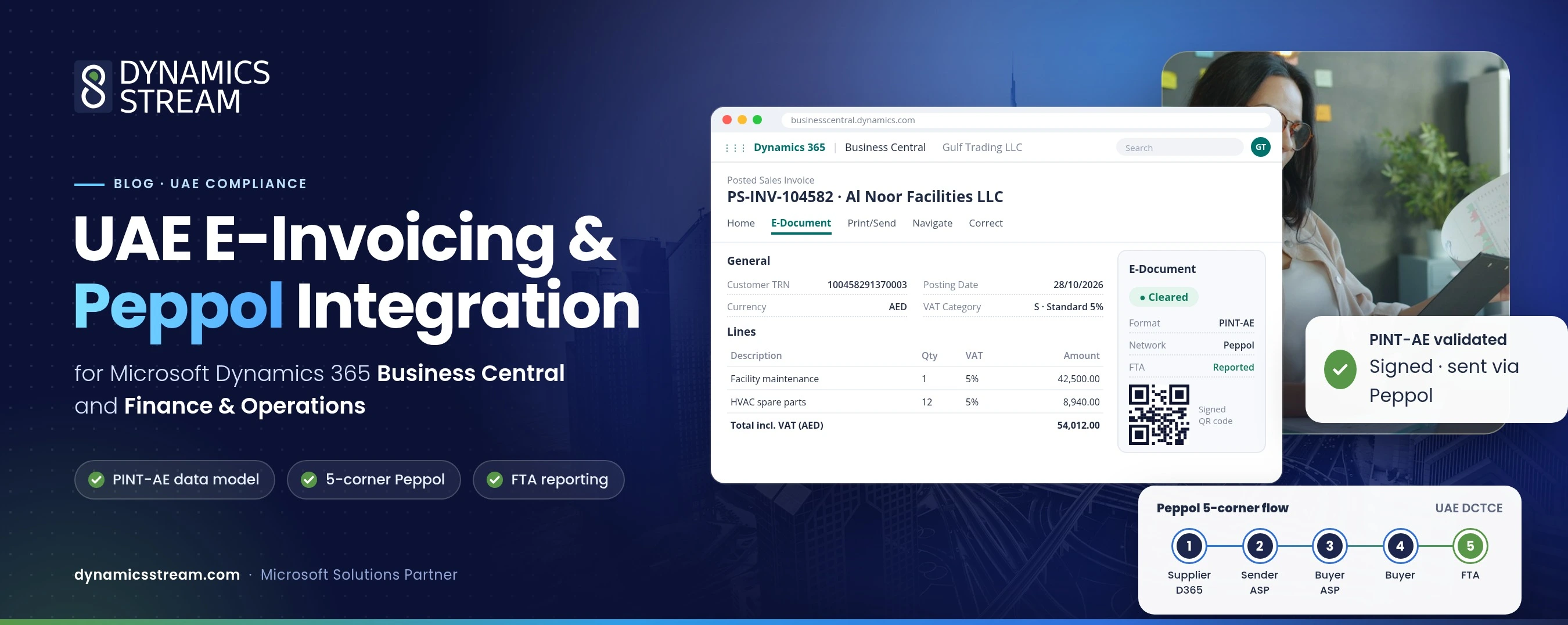
The UAE’s national e-invoicing mandate utilizes a decentralized Continuous Transaction Control and Exchange (DCTCE) framework built upon the international OpenPeppol network. Unlike basic e-invoicing models where data is simply emailed or uploaded post-facto, this model relies on a 5-Corner architecture:
-
Corner 1 (Sender): The supplier issuing the sales invoice within Microsoft Dynamics 365.
-
Corner 2 (Sender’s Access Point / ASP): The FTA-approved Accredited Service Provider receiving data from Dynamics 365.
-
Corner 3 (Receiver’s Access Point / ASP): The service provider receiving the validated invoice on behalf of the buyer.
-
Corner 4 (Receiver): The corporate buyer or government entity receiving the purchase document.
-
Corner 5 (Tax Authority): The Federal Tax Authority (FTA), which receives authenticated, real-time transaction reporting directly from Corner 2/3.
Because businesses cannot connect their internal ERP systems directly to Corner 5 without intermediary certification, integrating Dynamics 365 with an accredited partner is mandatory.
Standardizing Transactions: The Peppol PINT-AE Data Model
A primary technical pillar of this regulatory update is data format standardization. The UAE has adopted the Peppol International (PINT) standard specifically localized as PINT-AE.
General XML or JSON schemas do not pass validation on their own. Complete Peppol PINT-AE compliance requires that every invoice emitted from Dynamics 365 Business Central or F&O adheres strictly to standardized field mappings, tax categorization, and document syntax.
Essential data requirements include:
-
Tax Registration Numbers (TRN): Validated 15-digit TRNs for both supplier and buyer, mapped to verified master records.
-
Standardized Tax Categories & VAT Codes: Explicit categorization of standard rated (5%), zero-rated, exempt, and out-of-scope line items aligned with UAE VAT Law.
-
Currency & Exchange Mechanics: Dual currency tracking when invoicing in foreign currencies, including explicit conversion rates to United Arab Emirates Dirham (AED).
-
Item Identifiers & Commercial Metadata: Detailed descriptions, Harmonized System (HS) codes where applicable, payment bank IBANs, and strict document reference IDs.
When transactions are posted in Dynamics 365, the system must translate native tables, such as Sales Invoice Header and Sales Invoice Line in Dynamics 365 Business Central into this standardized PINT-AE payload before passing it downstream.
Architectural Pathways: Connecting Dynamics 365 to Accredited Service Providers (ASPs)
To link Dynamics 365 Business Central or F&O to an FTA-accredited provider, engineering teams typically choose between two primary technical approaches:
1. Embedded AL Extension (Business Central Native)
For Dynamics 365 Business Central cloud tenants, an AppSource extension or customized AL extension is deployed. This model hooks directly into standard posting codeunits (such as Codeunit 80: Sales-Post). When a billing specialist posts an invoice, the extension validates required data fields, sends an API request to the ASP, and writes the resulting UUID, digital signature, and verification status back into the Posted Sales Invoice page.
2. Integration Middleware via Azure Integration Services (Enterprise F&O & Hybrid BC)
For complex environments running Dynamics 365 Finance & Operations or hybrid multi-entity setups, a decoupled integration pattern using Azure Logic Apps or Azure Functions provides enterprise-grade flexibility. Dynamics 365 emits business events or OData/REST calls to Azure, which handles data enrichment, maps the transaction to PINT-AE, and orchestrates the transmission to the ASP. This minimizes custom code overhead in the core ERP and isolates monthly ERP updates from external changes.
Step-by-Step Blueprint: Automating End-to-End Invoice Processing
Automating the invoicing workflow eliminates manual data entry, prevents reconciliation disputes, and avoids non-compliance penalties.
-
Master Data Cleansing: Conduct a structured audit within Dynamics 365 to verify that all customer and vendor registries feature accurate 15-digit TRNs, legal registered names, and standardized commercial addresses.
-
Pre-Posting Validation Checks: Configure validation rules in Business Central / F&O that inspect line items prior to posting. If a required PINT-AE field or tax exemption reason is absent, the posting action pauses, alerting the user immediately rather than facing rejection from the ASP.
-
Automated Payload Generation & Transmission: Upon document posting, the secure integration pipeline translates transaction lines into the PINT-AE format and securely dispatches the file to the ASP via TLS 1.3 encrypted REST APIs.
-
Digital Signature & QR Code Ingestion: The ASP validates the syntax, routes the payload through the Peppol network, submits compliance data to the FTA, and returns an encrypted digital signature along with a verifiable QR code.
-
Storage & Customer Distribution: The ERP saves the cryptographic signature, status code, and audit reference inside the permanent posted record. Dynamics 365 then automatically generates the compliant customer-facing PDF/A-3 document with the embedded XML and emails it directly to the client.
Future-Proof Your Invoicing Workflows
The transition to continuous transaction monitoring represents an opportunity to improve financial operational hygiene across billing, collection, and VAT audit trails. Selecting an experienced Dynamics 365 partner in UAE ensures your ERP setup balances both statutory tax compliance and core system performance.
Modernize Your Tax Operations with Dynamics Stream
Is your enterprise ready for the UAE's mandatory e-invoicing transition? Dynamics Stream Software Solutions delivers certified integrations that connect Microsoft Dynamics 365 Business Central and Finance & Operations directly to FTA-approved Peppol Access Points.
Book a Free E-Invoicing Readiness Consultation with Dynamics Stream to audit your system setup, ensure end-to-end PINT-AE compliance, and automate your transaction pipelines without business disruption.
Written by:
Rabik Raja, Director Sales at Dynamics Stream Software Solutions LLC.
Share with







Give us your details.
We’ll get in touch.
Rabik Raja
Director Sales and Account Management
Mahmoud Mohamed
Dynamics 365 Sales Specialist


Our Readings