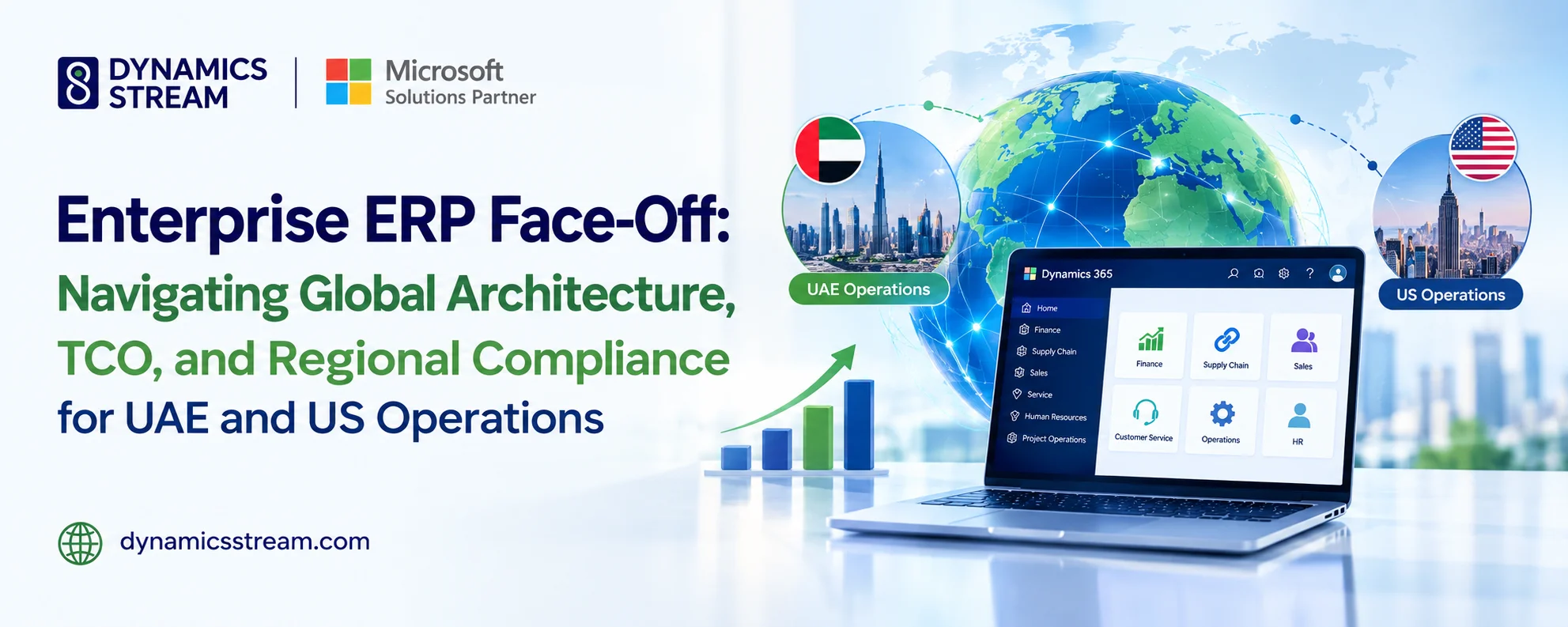
Enterprise ERP Face-Off: Navigating Global Architecture, TCO, and Regional Compliance for UAE and US Operations

For enterprise organizations scaling across the United States and the United Arab Emirates, deploying an Enterprise Resource Planning (ERP) platform is a long-term architectural decision. Operating across these two economic hubs requires navigating distinct statutory demands from the UAE’s Federal Corporate Tax (9%), FTA VAT audit files (FAF), and electronic invoicing mandates to US multi-state sales tax nexus, ASC 606 revenue recognition, and intercompany consolidations under US GAAP.
When modernizing financial and operational systems, technology leaders frequently compare market incumbents to identify the right platform fit:
-
SAP vs Dynamics 365
-
Oracle vs Dynamics 365
-
Odoo vs Dynamics 365
-
NetSuite vs Dynamics 365
-
Business Central vs SAP Business One
-
Dynamics 365 Finance vs Oracle Fusion
Here is an architectural, financial, and operational analysis comparing how Microsoft Dynamics 365 evaluates against competing ERP ecosystems across both regions.
Microsoft Dynamics 365
Dynamics 365 operates on Microsoft’s Dataverse and Azure hyperscale cloud. Its architectural core relies on the AL language runtime, which isolates bespoke customizations as independent extensions running over the base application code. This setup avoids version-locking, allowing Microsoft to deploy continuous monthly updates without breaking tailored business logic.
Because it shares common data definitions across Microsoft 365, Power Platform (Power Automate, Power Apps, Power BI), and Azure Synapse, enterprises eliminate integration middle-tiers. Data can reside natively within localized Azure regions, such as UAE North (Dubai), UAE Central (Abu Dhabi), or US East/West satisfying sovereign data residency standards.
NetSuite, Oracle Fusion & SAP
-
In any detailed NetSuite vs Dynamics 365 analysis, NetSuite's proprietary SuiteScript and SuiteFlow model provides rapid form adjustments, but scaling cross-border operations frequently requires external iPaaS connectors (like Celigo or Boomi) to move ledger data into external business intelligence lakes.
-
When assessing Oracle vs Dynamics 365 and evaluating Dynamics 365 Finance vs Oracle Fusion, Oracle Fusion provides deep financial modeling suited for massive conglomerates. However, its high deployment complexity, rigid configuration layers, and steep licensing tiers demand multi-year implementation cycles compared to the modular deployment speed of Dynamics 365 Finance & Supply Chain.
-
In the mid-market segment, comparing Business Central vs SAP Business One shows SAP Business One often running on legacy, on-premise architecture or hosted SQL/HANA instances requiring heavy add-on maintenance. In contrast, Dynamics 365 Business Central offers a pure multi-tenant cloud environment with direct AppSource extensibility.
-
At the tier-one enterprise tier, reviewing SAP vs Dynamics 365 (S/4HANA vs. Dynamics 365 F&SCM) highlights that while SAP provides deep discrete manufacturing routines, Dynamics 365 delivers lower total implementation overhead, faster time-to-value, and native integration with daily productivity tools like Microsoft Teams and Excel.
-
For growing businesses evaluating Odoo vs Dynamics 365, Odoo’s open-core Python apps offer an accessible starting point, but rapidly encounter stability and compliance bottlenecks when managing multi-entity global tax compliance, automated bank reconciliations, and complex supply chain governance.
Architectural & Functional Benchmark
| Evaluation Criteria | Microsoft Dynamics 365 (BC / F&SCM) | Oracle NetSuite / Oracle Fusion | SAP Business One / S/4HANA | Operational Impact |
|---|---|---|---|---|
| Data Fabric | Common Data Model (Dataverse), direct Azure Synapse link | Proprietary Oracle DB schema | SAP HANA in-memory database | Dynamics allows direct BI/AI ingestion without complex ETL. |
| Extensibility Model | AL Extensions via VS Code (zero core edits) | SuiteScript 2.0 / Java extensions | ABAP / Core modifications | Dynamics eliminates version-locking during platform updates. |
| Productivity Sync | Bidirectional sync with Microsoft Teams, Excel, Outlook | Add-on plugins or third-party APIs | Add-ons or batch sync files | Dynamics reduces context switching across daily sales and ops tasks. |
| UAE Regulatory Fit | Out-of-the-box FTA VAT audit files & e-invoicing | SuiteTax engine (often requires regional localization add-ons) | Localization notes / Partner-built add-ons | Dynamics natively aligns with UAE e-invoicing requirements. |
| US Regulatory Fit | ASC 606 revenue rules, native tax APIs (Avalara/Vertex) | Built-in SuiteTax + Advanced Revenue Management (ARM) add-on | Advanced Revenue Compliance modules | Dynamics avoids recurring fees for complex multi-state entity structures. |
| Autonomous AI | Microsoft Copilot embedded across daily transactional screens | NetSuite Text Enhance / Oracle AI | SAP Joule AI assistant | Copilot automates conversational ledger inquiries and bank reconciliations natively. |
Regional Compliance: UAE (FTA & E-Invoicing) vs. USA (GAAP & Multi-State Nexus)
The UAE Regulatory Framework
The United Arab Emirates enforces a 9% Federal Corporate Tax regime, strict Federal Tax Authority (FTA) audit obligations, and a phased national e-invoicing rollout.
-
Dynamics 365: Localized to output compliant FTA Audit Files (FAF) and generate cryptographically signed XML invoice transactions natively. Built-in setups configure corporate tax calculations, reverse-charge mechanisms for free zone cross-border logistics, and automated UAE Wage Protection System (WPS) bank files directly from the payroll ledger.
-
Oracle & SAP Ecosystems: Whether running Dynamics 365 Finance vs Oracle Fusion or Business Central vs SAP Business One, competing platforms frequently depend on third-party localized bundles to generate compliant bilingual Arabic-English tax invoices and align with local banking formats.
The US Regulatory & Accounting Framework
Operating in the United States requires managing multi-state sales tax nexus rules and maintaining strict ASC 606 revenue recognition under US GAAP.
-
Dynamics 365: Scales smoothly for multi-company architectures through cross-company data sharing, intercompany accounting, and continuous consolidation ledgers, connecting directly to tax engines like Avalara AvaTax and Vertex.
-
NetSuite & Odoo Realities: In NetSuite vs Dynamics 365 comparisons, NetSuite OneWorld handles multi-subsidiary rollups well, but requires purchasing the separate Advanced Revenue Management (ARM) module to meet ASC 606 standards. In Odoo vs Dynamics 365 comparisons, community-built Odoo modules often struggle to maintain automated compliance across complex multi-state US tax jurisdictions.
Artificial Intelligence: Copilot vs. Legacy ERP Intelligence
Generative and predictive intelligence within ERP systems moves teams away from manual data entry toward automated exception handling:
-
Microsoft Dynamics 365 Copilot: Embedded into operational screens across Business Central and Finance & Supply Chain. It conducts natural language variance inquiries (e.g., "Highlight gross margin variances exceeding 6% between US and UAE distribution centers in Q3"), automates collections correspondence, and matches unallocated bank ledger transactions using predictive algorithms reducing monthly financial closing timelines by up to 40%.
-
Competitor AI Implementations: In Oracle vs Dynamics 365 and SAP vs Dynamics 365 evaluations, Oracle’s OCI-based AI and SAP’s Joule offer helpful workflow suggestions, but lack direct semantic integration across desktop productivity ecosystems like Microsoft Teams, Excel, and SharePoint.
-
Licensing Structure & Modularity: NetSuite and Oracle Fusion subscription models combine base instance fees with modular pricing (charging extra for modules like Fixed Assets, Advanced Financials, and multi-subsidiary consolidations). Dynamics 365 operates on a named-user model, offering distinct tiers for Full Users and Team Members to keep license footprints optimized for operational staff.
-
Integration Middleware Costs: Companies running external ERP platforms alongside Microsoft productivity software often pay between $15,000 and $45,000 annually for iPaaS connectors and API usage limits. Dynamics 365 shares a unified schema with Microsoft 365 and Power Platform, eliminating recurring middleware costs.
Why Microsoft Dynamics 365 Implementation Is Mission-Critical for UAE Businesses
The UAE’s commercial environment is modernizing rapidly. With the enforcement of Federal Corporate Tax (9%), strict FTA VAT reporting, and the nationwide rollout of the E-Invoicing mandate, operating on fragmented legacy software or entry-level accounting tools introduces genuine regulatory risk.
Implementing Microsoft Dynamics 365 transforms enterprise operations by delivering:
-
Guaranteed Regulatory Compliance: Automatically generate FTA-compliant tax audit files (FAF) and interface with the UAE e-invoicing network via cryptographically signed XML transactions.
-
Consolidated Multi-Entity Financials: Manage mainland and Free Zone entities, cross-border trade tariffs, and multi-currency reconciliations in a unified financial ledger.
-
Supply Chain & Warehouse Velocity: Gain end-to-end traceability across regional distribution hubs, free zone bonded warehouses, and port terminals with predictive inventory planning powered by Microsoft Copilot.
-
Data Sovereignty Assurance: Deployed inside Microsoft’s localized Azure UAE data centers (Dubai and Abu Dhabi), enterprise data remains secure and compliant with regional data residency regulations.
Accelerate Your Enterprise Transformation with Dynamics Stream
Selecting the ideal ERP platform is only half the equation, long-term success depends on your implementation partner's technical depth, architectural rigor, and regional domain experience.
Dynamics Stream is a Microsoft Solutions Partner operating across Dubai (UAE) and Brooklyn, New York (USA). With more than 200+ enterprise customers and a team of 90+ certified Dynamics 365 consultants, Dynamics Stream delivers reliable ERP deployments:
-
Proprietary UAE Compliance Accelerators: Pre-built IP suites covering UAE VAT compliance, Corporate Tax logic, bilingual Arabic-English invoicing engines, and automated UAE Wage Protection System (WPS) integrations.
-
Proven In-House Solutions: Proprietary AppSource-ready applications, including DS365 Purchase Requisition, DS365 Vendor Reconciliation, and DS365 Payroll for Finance & Operations.
-
Zero Data Loss Migration: Proven methodologies for migrating legacy ERP systems (Microsoft Dynamics AX, NAV, GP, QuickBooks, or custom legacy databases) to cloud-native Dynamics 365 with complete data integrity.
-
Global Footprint, Localized Execution: Experienced solution architects located in Business Bay, Dubai, and Brooklyn, New York, providing synchronized support across GCC and North American operating hours.
Ready to Modernize Your Enterprise Operations?
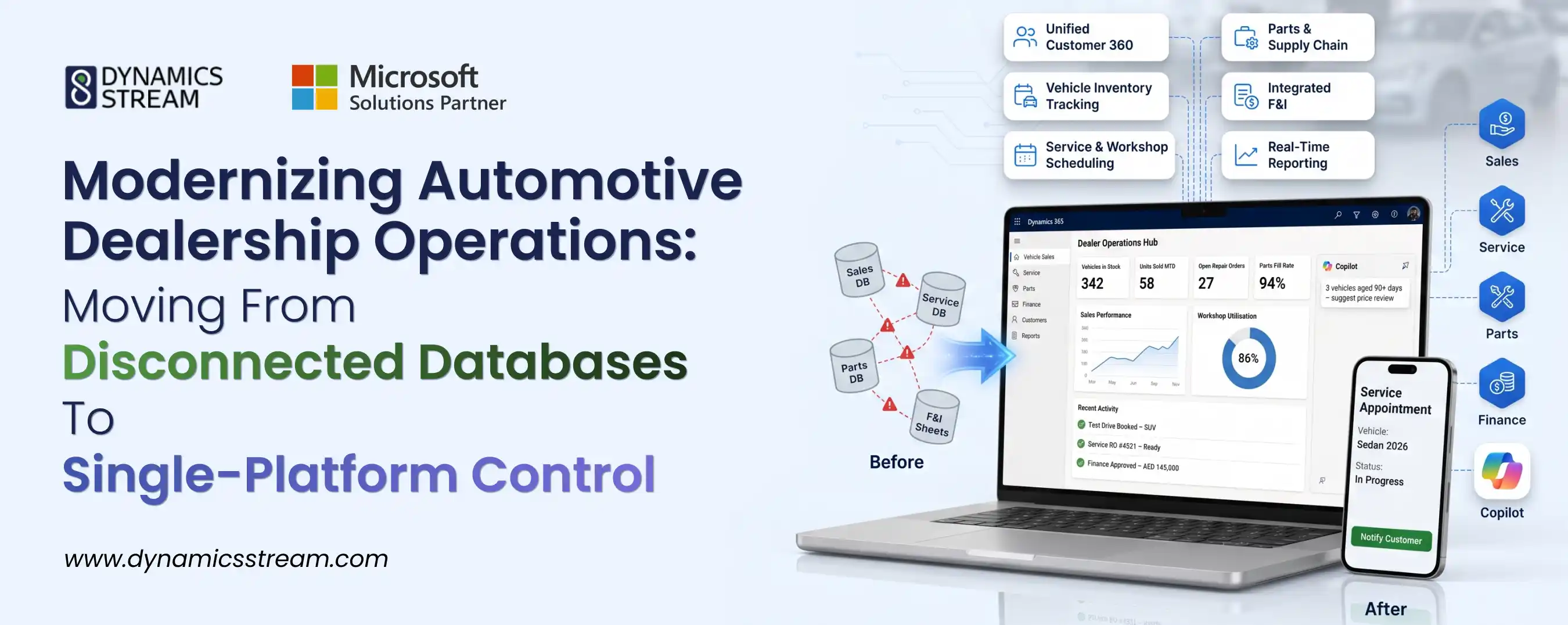
Stop letting disconnected databases, manual reconciliations, and compliance shifts slow your operational growth.
Connect with our senior Dynamics 365 solution architects in Dubai or New York to review your functional requirements, evaluate technical feasibility, and map out your deployment roadmap.
Schedule a Free Architectural Consultation with Dynamics Stream.
Written by:
Rabik Raja, Director Sales at Dynamics Stream Software Solutions LLC.
Share with





Give us your details.
We’ll get in touch.
Rabik Raja
Director Sales and Account Management
Mahmoud Mohamed
Dynamics 365 Sales Specialist


Our Readings